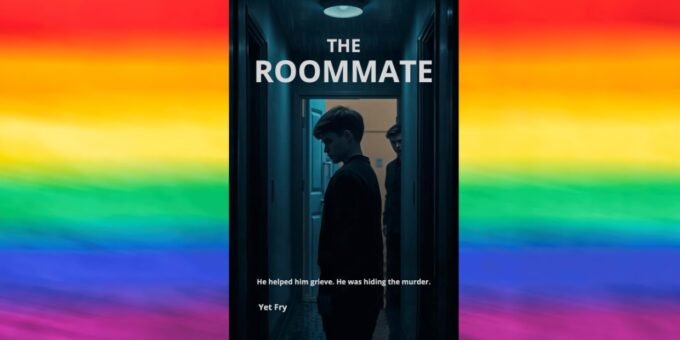
When the Person Helping You Is the One You Should Fear Most
What if the person who showed up to save you was the very reason you needed saving?
That question sits at the dark, beating heart of The Roommate — a psychological thriller that understands something most books about grief and manipulation never dare say out loud: the most dangerous predators don’t come for you when you’re strong. They come for you when you’re already broken.
The Loneliness No One Talks About
There is a particular kind of isolation that follows the loss of a partner — one that is even more acute, even more invisible, when that relationship existed outside the boundaries of what the people around you were willing to acknowledge. You grieve in silence. You absorb the suspicious glances. You hear people rush past your pain toward the comfort of a tidy explanation. And somewhere beneath the grief, a more terrifying question begins to take shape: What if no one ever believes me?
For LGBTQ+ young people navigating loss in hostile or indifferent environments, this fear is not abstract. It is the texture of daily life. The police closed the case. The family demands silence. The institution that should protect you instead becomes another wall. Into that vacuum — that raw, desperate space where you are most vulnerable — steps someone who seems to understand. Someone who listens. Someone who, for the first time since everything fell apart, makes you feel not completely alone.
That is precisely when you are in the greatest danger.
A Story Built From the Darkest Truths
The Roommate was written for readers who know what it feels like to have their reality questioned, their grief dismissed, and their trust weaponized. This is not a thriller that uses trauma as decoration. It is a story that takes the specific psychological terror of gaslighting and grief manipulation seriously — and gives it a face, a name, and a reckoning.
Set against the cold landscape of West Lafayette, Indiana, the novel follows Robbie Walsh in the aftermath of his boyfriend Mark’s death — a fall from a bridge the police ruled an accident with unsettling speed. Shattered, isolated, and carrying a grief no one around him seems willing to hold, Robbie is exactly the kind of person a skilled manipulator would target. Then Billy Morgan appears: calm, compassionate, a junior psychology major who seems almost supernaturally attuned to Robbie’s pain. He listens when no one else will. He validates Robbie’s fears. He becomes, in the absence of anyone else, indispensable.
What Robbie doesn’t know — what he cannot yet see — is that Billy works for the New Dawn Foundation, a secretive network with ties to conversion therapy camps and a documented history of violent cover-ups. Billy’s assignment is precise: keep Robbie under control and ensure the truth about Mark’s death never surfaces. What makes The Roommate extraordinary is the moment when that professional mission curdles into something far more disturbing. When Robbie discovers Mark’s class ring hidden in Billy’s lockbox, the novel’s entire architecture shifts. The ring is not evidence of a job. It is a trophy. And trophies belong to obsession.
What This Book Teaches You About Surviving the Unthinkable
One of the most quietly powerful insights woven through The Roommate is that survival sometimes requires performance. Robbie must continue living alongside a man he has come to fear — smiling, trusting, appearing unaware — while secretly gathering evidence that might save his life. Billy, meanwhile, performs compassion with clinical precision, mirroring Robbie’s grief back to him in ways meant to deepen dependency rather than encourage healing. The author frames this double performance not as deception but as necessity: when institutions fail you, when the police won’t listen, and the family demands silence, the ability to mask your knowledge becomes a survival skill.
The novel also delivers a crucial, practical truth about evidence: it must be distributed to be safe. Robbie’s strategy — copying files to cloud storage, emailing documents to multiple accounts, and preserving physical proof across different locations — reflects a principle that whistleblowers and survivors of institutional abuse have long understood. A single point of seizure can erase everything. Spreading the truth makes it harder to bury. And the final piece of that strategy — reaching investigative journalist Anya Sharma — illustrates something equally important: evidence needs a credible, protected channel. Digital copies can be dismissed as fabrications. A living witness carrying physical proof is something else entirely.
The book’s most haunting line arrives near the end, delivered in a recovered message from Mark’s phone, sent moments before his death: “He says his name is William.” Four words. A name. And suddenly, the conspiracy has a human face. Another character, Marta, cuts to the heart of Billy’s methodology when she says, “They always use your love against you. Your love for the person you lost, your need to be loved afterward. It’s the oldest play in the book.” This is not just a thriller observation. It is a warning — and a recognition — for anyone who has ever been made to feel that their grief made them weak, when in fact it made them a target.
Why This Story Matters Right Now
The Roommate arrives at a moment when LGBTQ+ young people are navigating a world in which institutions — from mental health systems to law enforcement to family structures — can be weaponized against them rather than used to defend them. The New Dawn Foundation in this novel is fictional. The dynamics it represents are not. Conversion therapy networks, cover-ups of suspicious deaths, and the systematic destruction of a vulnerable person’s credibility — these are not inventions of dark fiction. They are documented realities that rarely receive the kind of unflinching narrative attention they receive in this novel.
What makes this novel essential reading is not just its plot — though the plot is relentless, propulsive, and deeply unsettling in the best possible way. It is the emotional accuracy with which it captures the experience of being gaslit by someone you trust during the most vulnerable period of your life. The psychological exhaustion of constantly questioning whether your perceptions are real. The loneliness of being the sole witness to your own persecution. The impossible calculus of confronting danger without proof that anyone will believe you. Readers who have lived through any version of this experience will recognize themselves in Robbie — and, through his journey, discover that survival is possible even when every institution has failed you and every ally seems to carry a hidden cost.
Begin the Journey That Changes Everything
The moment Robbie finds Mark’s ring in that lockbox, the story transforms — and so does the reader’s understanding of how obsession, manipulation, and grief can affect the human soul. The Roommate is a fast-paced, psychologically devastating thriller that will keep you reading through the night and thinking for days afterward. It is a book for anyone who has ever been told their grief was too loud, their suspicions too extreme, or their truth too inconvenient for the powerful people who needed it buried.
Don’t let the truth remain hidden. Discover what Robbie uncovers — and what it costs him to survive it. Get your copy at AMAZON.
Enjoy LGBTQIA+ books, movies, and queer culture?
Join us on Social Media.
Facebook | BlueSky | Instagram | Threads | Printrest
#QueerThriller #LGBTQBooks #PsychologicalThriller #GaslightingAndManipulation #GriefAndLoss #DarkFiction #TheRoommate #QueerFiction #ConspiracyThriller #TrustAndBetrayal